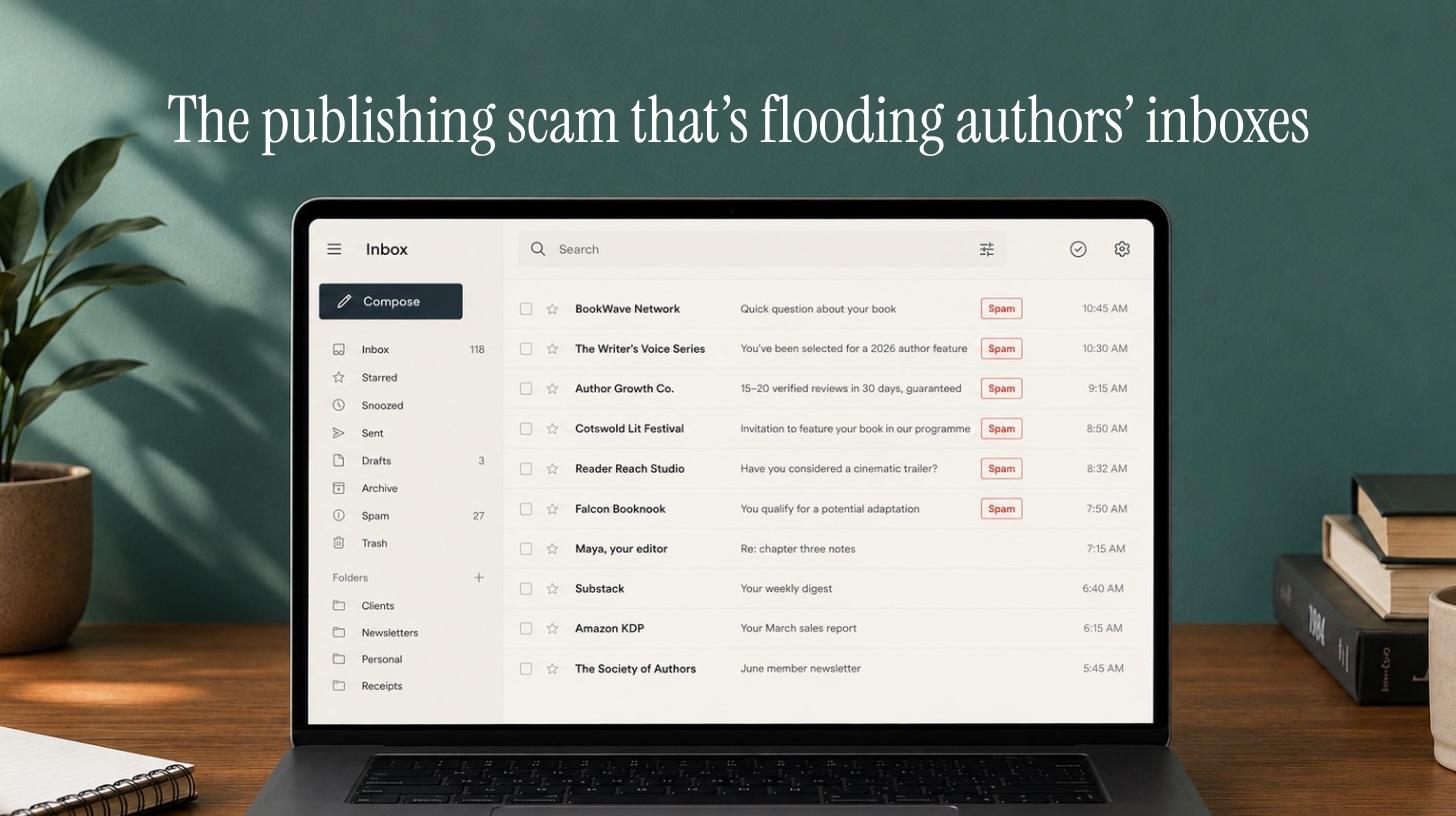
The book marketing scammer is in your inbox right now
A guide to the emails flooding authors, written from the strange vantage point of someone who's started getting them too.
I help authors get their books in front of readers but suddenly I'm finding myself on the receiving end of "people" purporting to be just what I need to actually get noticed.
A steady drip of strangers promising they can do exactly that, guaranteed, this week, for a small fee. Scammers, disguised as the very people authors are looking for.
This month the drip turned into a flood. "Hello Author," one opened, neither knowing nor caring whether I'd written so much as a shopping list. Another praised the "quality of the writing and the strength of the concepts" in a book it had plainly never opened. A third offered to put a book on Netflix. They arrive in twos and threes, most landing in spam, a few clever enough to dodge the filter.
And that's the point. If they're hitting me, someone who can spot the con halfway through the first line, they're carpet-bombing every author who can't. And some of these emails are very, very good at their job.
I've spent the last few weeks reading through a stack of them, my own and those forwarded by several authors I know who are getting hit even harder. One of them got pulled into a long, painful con that ran for months. It's the same playbook every time, just with different masks. Once you've seen the patterns, you can't unsee them. So here they are.
First, the scale of it, because this isn't a few stray emails
This is now an industry. In early 2025 the US Department of Justice charged three people over a scheme that defrauded mostly elderly authors of nearly $44 million, by convincing them that publishers and filmmakers wanted to turn their books into blockbusters, as long as they paid some fees first. That operation ran for years out of a company that looked, from the outside, like a real publisher.
The trade bodies have been shouting about it. The Authors Guild keeps a running scam-alert page. Writer Beware, the long-running watchdog, now maintains a whole "impersonation list" because the problem got big enough to need one. The Hollywood Reporter ran a piece in its April 2026 AI issue titled "A New AI Scam Is Targeting Thousands of Authors. I Was One of Them," because chatbots have made the flattery cheap, fluent and infinite.
Now to the emails themselves.
The five cons
Strip away the warm words and almost everything I read fell into one of five cons.
The famous author who emails you personally. A note from a household-name bestseller, telling you they admire your work and want to add it to their private "reading list" or "travelling book cart." Real bestselling authors do not cold-email strangers from a Gmail address to champion their manuscripts. They're busy being bestselling authors.
The scammer disguised as a real brand. Someone claiming to work with BookBub, Goodreads, a literary agency you can actually look up, or a real book club. The organisation exists. The sender has nothing to do with it. Silent Book Club had to post a public warning because so many scammers were impersonating its organisers that it now states plainly: any genuine message comes from its own domain, and no one is authorised to ask authors for money.
The paid "editorial feature." An invitation to be interviewed for a curated radio-style series "in the spirit of BBC Radio 4," or spotlighted by a newspaper you've half heard of, with your story "syndicated across USA Wire, AP News and TechBullion." Those last ones are press-release dumping grounds, not journalism. Somewhere near the end, gently, "a small service fee applies."
The festival or prize invitation. "We'd be honoured to feature you in our 2026 programme." Then a placement fee. Real festivals pay their speakers, or at the very least host them for nothing. They do not ask you to wire money to take part.
The soft opener. The most modern one, and the cleverest. No pitch at all. Just "Quick question about your book" or "What do you think?" or "Are you available for a brief chat now?" The whole goal is to get you to reply. The reply tells them your inbox is live and you're willing to talk. Bang. You are in their funnel.
The tells, which are the same no matter the disguise
The disguises change. The body underneath doesn't. Print this and stick it on the wall.
They write from Gmail and dress it up. A festival emailing from [email protected]. A "publisher" using a domain that puts the real company's name in front of an address that isn't theirs. One author got an invitation from the "Giller" prize, and the only thing that gave it away was the email address: it said "Griller," not "Giller." Read addresses character by character, slowly, every time.
They don't actually know your book. The flattery is gorgeous and completely generic. Often the book isn't named at all. Sometimes they name the wrong one. One author got a string of "personalised" video trailers for entirely the wrong title, blamed each time on "software syncing the wrong folder." What that really means is they're running this on hundreds of people at once and grabbed the wrong file. My favourite tell of the lot: the opener that arrived addressed to a completely different author about a completely different book, then carried on pitching them anyway.
The numbers are inconsistent. One "book influencer" claimed 3.2 million readers in one email and 5 million in the next. Fees that start at one figure and quietly climb. Who forgets the size of their own audience by two million?
They guarantee things no honest person can. "15 to 20 verified reviews in 30 days." "Review velocity." Guaranteed Amazon rankings. A Netflix deal. Pause on the reviews one in particular, because this is dangerous: organised or incentivised reviews break Amazon's rules and can get your reviews stripped and your account shut down. Real help never promises review numbers, because the only safe reviews are the ones you didn't pay for.
The sycophantic arse-kissing and legacy language. "Your legacy." "Generational wealth." "Passed down to your next of kin." "Because of your age." This is grooming language, designed to make you feel seen and looked after while the ask gets bigger. One author I know was told, the moment he tried to cancel, that they'd keep working "for free." This is NOT them being generous. They'd already harvested his social media passwords, and the free offer was them refusing to let go of the accounts. The money was never the real prize. The access was.
The seams show if you look carefully. Template brackets left in the text, "I'm a [creative collaborator]," "open to a brief [chat]." Stray characters from other alphabets pasted in by mistake. Typos in the subject line, "Youre qualify for potential adaptation." The same fake names and outfits cropping up across supposedly unrelated senders. It's one machine wearing a lot of faces.
Payment gets strange fast. A US dollar amount for a festival in England. A request to pay by Western Union into a personal checking account in an individual's name. Haggling, an actual negotiation, over the fee. Real organisations invoice from a business account and don't barter.
The trap I have to warn you about: not every fee is a scam
Here's where most "spot the scam" advice falls down, and where you need to be careful, because the scammers exploit exactly this confusion.
Paying for promotion is not, by itself, a red flag. Reputable book clubs do charge a service fee for author spotlights. BookBub Featured Deals are real, paid, and competitive. Publicists, ads and promo sites are a normal part of launching a book. If I told you "never pay for anything," you'd ignore me by next week, because you know that's not how the industry works.
So the question isn't whether money changes hands. The question is:
Did they contact you out of the blue claiming you were "selected"?
Are they writing from a free email account while representing a "company"?
Is the praise generic and the company impossible to verify?
Does the story fall apart the moment you search the name?
Are you being asked to pay to be "chosen," rather than buying a clearly described service from someone with a traceable track record?
A real service survives a search. A scam usually reveals itself the moment you start investigating it.
The one habit that protects you
The authors I know who haven't been burned all did this one thing. When something tempts them, they go to the real organisation directly and ask.
One emailed a publisher's actual fraud team about an "editor" who'd approached him. Scam, they confirmed, and they see it constantly. Another contacted a festival directly to check an invitation. Not us, they said. A third used a literary prize's own website to ask about a "book club" trading on its name. Also fake, they replied, and they thanked her for flagging it.
That's the author's first line of defence, and it's free.
Don't reply to the suspicious email to check, because replying is exactly what they want. Open a new tab, find the real organisation's real website, and ask them yourself. The publishers, festivals and prizes being impersonated will tell you the truth, because they hate this as much as you do.
What this is really about
These scams work because the longing is real. You wrote a book and you want it to be read. That is precisely what the scammer is preying on.
So protect yourself by being unsentimental about the inbox. Delete, block, and don't reply. Check directly when something tempts you. And tell the authors in your life, especially the older ones and the ones launching their first book alone, that the warm, flattering, "we found you" email is the one to distrust most.
Real opportunities don't arrive from a Gmail account with a misspelt name.
Where to check, all free and real
The Authors Guild publishing scam alerts: authorsguild.org/resource/publishing-scam-alerts
Writer Beware's impersonation list and scam archive: writerbeware.blog
The Alliance of Independent Authors Watchdog Desk, which rates publishing services and names known scams: allianceindependentauthors.org/watchdog
The Society of Authors and Writers' Guild of Great Britain joint scam guidance (UK), including a checklist for testing any offer: societyofauthors.org
Penguin Random House's anti-fraud page (most big publishers run one): penguinrandomhouse.com/prh-fraud
The US DOJ release on the $44m publishing scam, if you want to see the scale: justice.gov/usao-sdca
If you've been targeted, report it
Report Fraud, the UK's national fraud reporting service (replaced Action Fraud in December 2025): reportfraud.police.uk or 0300 123 2040
The FBI's Internet Crime Complaint Center, for reporting from the US: ic3.gov
Want the intel first? Author Intel is our newsletter for authors who want straight-talking book marketing thinking, no fluff. Subscribe here.
New here? Start with the 90-second Launch Readiness Quiz to see how prepared your book is for launch.