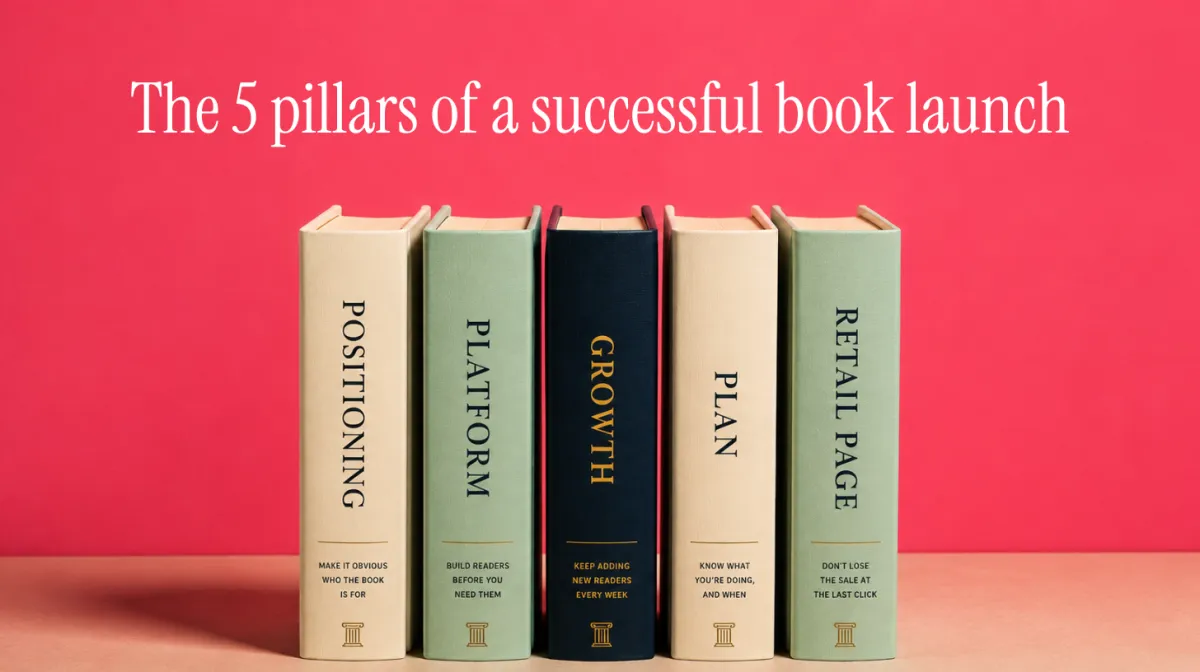
The 5 pillars of a successful book launch
Most books don't fail because they're badly written.
They fail because almost nobody sees them.
That's usually a marketing problem, not a writing problem. And unlike your reviews, Amazon's algorithm, or a celebrity mentioning your book on TikTok, marketing is largely under your control.
We've spent a lot of time analysing launches that took off, and launches that quietly disappeared. They almost always come down to the same five things.
Before we get into those five, a quick bit of context on what your book is walking into. Because the competition has changed dramatically over the last few years.
Over 4 million books were published in the US in 2025. That's a 32.5% jump on the year before. Most of that growth came from self-publishing, which alone accounted for 3.5 million titles.
Roughly half the 58,000 traditionally published trade titles that BookScan tracks each year sell fewer than 12 copies. The average book, across the whole US market, sells fewer than 300 print copies in its entire lifetime.
Those numbers aren't there to depress you. They're there so you know what your book is up against.
The 5 pillars
We're not going to pretend every book that succeeds does so because of these five pillars, and every book that fails does so because it missed one. Some launches catch a lucky break. Others have bigger budgets, stronger publisher backing, or perfect timing. But of every launch we've ever pulled apart, these five are where the difference gets made.
Positioning — make it obvious who the book is for
Platform — build readers before you need them
Growth — keep adding new readers every week
Plan — know what you're doing, and when
Retail page — don't lose the sale at the last click
Let's take them one at a time.
Pillar 1: Positioning
Make it obvious who the book is for.
If you can't say who your book is for in one sentence, no one else can either.
We say this a lot because we see it constantly. Authors who can articulate exactly who they're writing for, and why that reader will care, sell more books.
The Authors Guild's 2023 Author Income Survey of 5,699 published authors found that full-time romance authors earned a median of $31,725 from books. That's over three times what mystery and thriller writers earned, and more than six times what literary fiction writers earned.
Romance isn't magic. It's tightly defined.
Readers know exactly what they want. Writers know exactly who they're writing for. Categories are precise. Comps are easy to identify. Every conversation between writer and reader happens in a shared vocabulary.
The looser the audience, the harder the sale.
Indies quietly dominate this space too. The Alliance of Independent Authors 2024 report found that self-published titles held over 50% of Kindle's Top 400 in 2023. Indies aren't outselling traditional publishers because they write better books. They're outselling them because they treat the book like a product and make sharper decisions about category, keywords, and comps.
The biggest positioning mistake we see? Authors describing their book, when they should be describing their reader.
Readers don't buy books simply because of what they're about. They buy them because they can imagine themselves enjoying them.
What positioning looks like when it's done properly:
You can name your ideal reader in one specific mental image. Not a demographic. A specific person.
You've picked three to five comp titles from the last three years, because that's what algorithms and booksellers are looking for.
You've named your angle. Not the plot. Not the topic. The reason a reader picks your book over the other twelve on the same shelf.
If those three aren't crisp, nothing else you do at launch will land properly. Positioning is the foundation.
Pillar 2: Platform
Build readers before you need them.
If we could only give authors one piece of launch advice, it'd be this.
Build an email list.
Not because marketers keep telling you to. Because every launch we've ever looked at comes back to the same thing. Authors who can reach readers directly sell more books.
The data backs it up.
Written Word Media's 2025 Indie Author Survey of 1,346 authors found that authors with a developed email list earn around $300 a month from books. Authors without a list earn around $15. A 20x gap.
The same survey found that authors earning $20,000+ a month have an average list size of 25,000 subscribers. That's not a coincidence.
Here's the twist though. 85% of surveyed authors already run a newsletter, according to BookBub Partners. 92% use email to announce new books. Having a list is the baseline now, not the thing that sets you apart.
What sets you apart is how you use it.
Consistent monthly emails to an engaged list will do more for launch week than any burst of last-minute activity. The authors who send a newsletter once and forget about it for six months are the ones who wonder why nobody buys when they finally announce a launch.
For context, most author newsletter platforms report open rates around 44% and click-throughs between 2% and 5%. But watch the opens carefully. Since Apple Mail Privacy Protection rolled out in 2021, open rates have been inflated everywhere. Emails that never got read still register as "opened." Click-through rate and click-to-open rate are the truer signals.
The simplest test we know is this: if your own newsletter landed in your inbox tomorrow, would you actually read it?
If your list is under 100 or you haven't emailed it in three months, that's your Pillar 2.
Pillar 3: Growth
Keep adding new readers every week.
Having a list matters. Growing it matters more.
Written Word Media's 2025 data shows this clearly. Authors classified as "growing" (their book income went up year on year) run newsletter cross-promotions with other authors 27% of the time. The overall author average is 17%. Growing authors actively use their newsletter 58% of the time versus 43% overall.
Growth isn't about follower counts. It's about specific behaviours the top slice does that most authors don't.
The biggest mistake we see here? Authors treating list growth as something they'll get to later. Later usually turns out to be six weeks before publication, which is too late.
The list you didn't build won't be there when you need it.
The mechanics.
Every author page needs a lead magnet that actually converts. Average landing pages across all industries sit at 2.35% conversion, according to OptinMonster. Well-optimised author freebies should be running at 5-7%. If your signup box says "join my newsletter" and nothing else, you're leaving conversion on the table.
Retention matters more than it did two years ago. The 2025 average email unsubscribe rate hit 0.22%, more than double 2024's 0.08%, according to MailerLite's 2025 benchmarks. That's Gmail making one-tap unsubscribes easier. Every subscriber you lose is harder to replace. Sending emails that are genuinely worth reading has never been more important.
Which brings us back to that earlier test. If your own newsletter landed in your inbox tomorrow, would you actually read it?
Pillar 4: Plan
Know what you're doing, and when.
Here's something most first-time authors work out too late.
Launch day isn't really the launch.
It's the exam.
The real launch happened in the six months beforehand.
Let's talk about reviews.
Northwestern's Medill Spiegel Research Center found that purchase likelihood for a product with five reviews is 270% greater than for one with none. That's the case for an ARC team, in a single number.
But the same study found something interesting. Purchase likelihood peaks between 4.0 and 4.7 stars. A perfect 5.0 actually reduces conversion, because readers assume the reviews are fake.
Which brings us to something we can't say strongly enough, and it links back to what we wrote in our last piece about author scams. Don't game reviews. Not by trading them. Not by paying for them. Not by exchanging services for stars. Amazon strips reviews and shuts down accounts for exactly this kind of thing, and even when it doesn't catch you, the pattern shows. Authentic ARC teams give a range of ratings because readers are honest. That range is what makes a book look real.
75% of consumers "always" or "regularly" read reviews before buying, according to BrightLocal's 2024 consumer review survey. Only 3% never do. Reviews aren't optional. They just have to be earned.
The rest of the launch plan.
A written plan with dates. Not one you keep in your head. Every week between now and publication has a job, and every job has a person. Yours, usually. That's fine, but write it down.
Content drafted in advance. Launch week is not the time to be figuring out what to post. Draft your emails, social content, and PR pitches in the months before publication. Publication day is when everything happens at once. Preparation is what lets you show up calmly instead of frantically.
A plan for weeks 2 through 12. Kindlepreneur's documented experiments on Amazon's "Popularity Effect" show that sustained sales velocity beats one-day spikes for lasting rank. A huge launch day followed by silence is worse than a steady drumbeat. Plan for the tail, not just the peak.
Pillar 5: Retail page
Don't lose the sale at the last click.
You can do everything else brilliantly and lose the sale on a badly written retail page.
The blurb does more work than most authors realise.
Written Word Media's reader survey of 3,589+ avid readers found that 57% of readers rank the book description as the most important factor when choosing a book. That's more than price. More than the author's name. More than anything else.
Your blurb has to work as a piece of copy, not a summary of the plot. This is the single most common mistake we see. Authors write the back-of-jacket summary and expect it to sell the book. A summary tells the reader what the book is about. Copy tells the reader why they should care.
The cover isn't artwork. It's marketing.
A cover on its own can account for a 30% swing in click-through, according to BookBub Partners' A/B tests. The test isn't whether you like the cover. It's whether it looks at home next to the current bestsellers in your genre.
Categories and keywords.
Categories aren't somewhere you click randomly five minutes before publishing. They're where readers actually find you. 83% of indie author revenue still comes from Amazon in 2025 (down from 91% in 2023 as authors diversify), so the Amazon page is where the money is.
Defaulting to Amazon's suggestions gives you the same categories as everyone else. Which is exactly the opposite of what you want.
You've just read the five pillars.
Now comes the awkward question.
Which one is quietly undermining your launch?
Most authors guess. The trouble is, we're usually good at spotting what we've already done, and much worse at spotting what we've missed.
Reading about the pillars is useful. Knowing exactly which one to work on first is much more useful.
That's why we built the Launch Readiness Quiz.
In about 90 seconds you'll get a personalised score across all five pillars, see what's already working, and find out the first thing we'd fix before your launch.